How to Use the Life Balance Wheel (Wheel of Life): Step-by-Step Guide with a Template
What the life balance wheel (wheel of life) is and how to use it in three steps: score where you are, set goals, and plan your next actions.

A great thing about the life balance wheel (also called the wheel of life) is that you don't need to wait until next Monday, next month or next year to start working on your life balance. It's a simple tool you can use right away — today, in about 20 minutes.
What is the life balance wheel?
The life balance wheel is a self-assessment tool. It shows how satisfied you are with each area of your life, side by side, so you can see the balance between them at a glance.
How does it work?
The wheel is usually divided into 8 areas. There can be more (usually up to 12), depending on how many areas you'd like to look at right now. The area names in the picture below are examples. You can keep them or change them to areas that suit you better.
Inside, the wheel is divided into a scale from 1 to 10, and this is where you'll do the work.
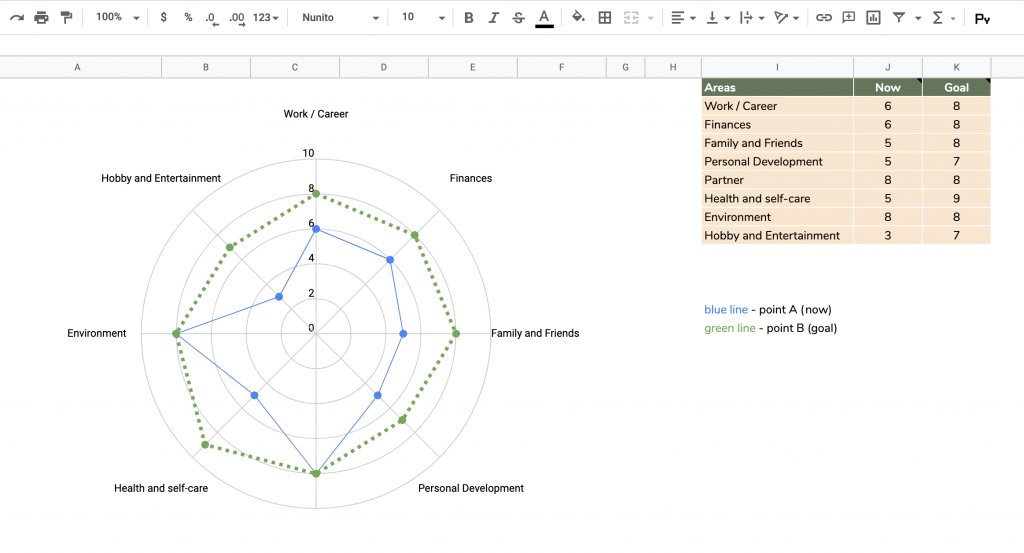
Once you've filled in every area, you'll see how round your wheel is. As we know, a wheel has to be round to roll. Life is the same: the rounder the wheel, the more balanced your life.
At the same time, it's okay if your wheel isn't perfectly even. At certain moments in life, some areas simply matter more than others. The main thing is to avoid very sharp dips and peaks. (A wheel doesn't need to be perfect to roll — good enough really is enough.)
Okay, let's get started!
Step 1: Point A — fill in your wheel as it is now
Your task is to rate how satisfied you are with each area of your life.
- If you use the interactive template, open the “Life Balance Wheel” tab and fill in the Now column with a number from 1 to 10. The wheel draws itself.
- If you use paper, draw a circle, divide it into 8 parts and mark a dot on each one by hand.
1 is the lowest score — the area is missing from your life completely. 10 is the ideal: you're completely satisfied with this area.
Step 2: Point B — set your goals
Now pick the number you'd like each area to reach and write it in the Goal column. (On paper, mark these dots in another color.)
It's best to start with the areas where you already score highest. That makes it easier to prepare for the areas that are lagging behind.
Try not to aim too high. If an area is at 2 right now, don't jump straight to 10 — set it 2–3 points higher. That's more realistic, and it won't feel like an impossible task.
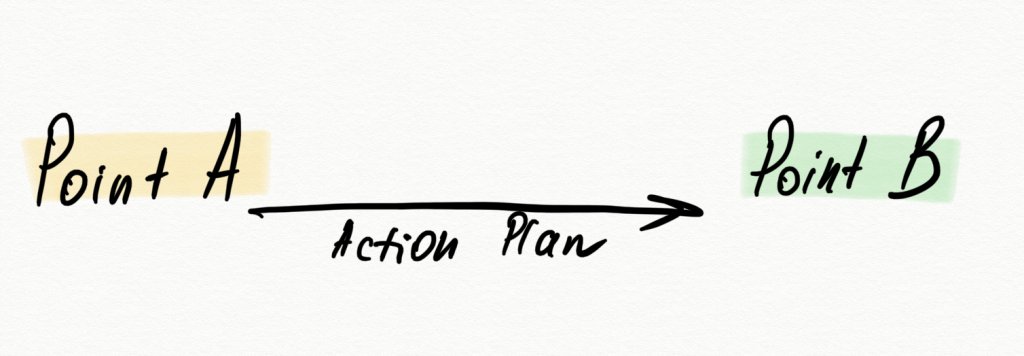
Step 3: Action! Plan how to get to Point B
To reach the goals you set in Step 2, you need a clear plan. Open the “Action plan” tab and write down the steps (actions) that will move each area toward its goal. Add a deadline wherever you can.
The template includes example steps for every area. Here are a few of them:

Keep the steps small. If you're already stretched thin, your plan may need to include saying no to a few things — free time for the areas you care about has to come from somewhere. And if every area feels low at once, start with what to do when you feel overwhelmed before setting big goals.
All done!
Now you can clearly see your Point A (where you are now), your Point B (your goal) and the path between them (your action plan).
Come back to your wheel in a month or two, score yourself again, and see what has moved.
Did the wheel show you anything surprising? We'd love to hear about it — write to us.
Questions people ask
What are the 8 areas of the life balance wheel?
A common set is work and career, finances, family and friends, personal development, partner, health and self-care, environment (your home and surroundings), and hobbies and fun. They're only examples — rename them, or add more (up to about 12) so the wheel fits your life.
How often should I fill out the wheel of life?
Every one to three months works well. Score yourself again, compare with your last wheel, and update your action plan. Many people also do it at the start of a new year or on their birthday.
Does my wheel have to be perfectly round?
No. At some points in life one area simply matters more than the others. What's worth paying attention to are very sharp dips and peaks — an area sitting at 2 while everything else is at 8.